
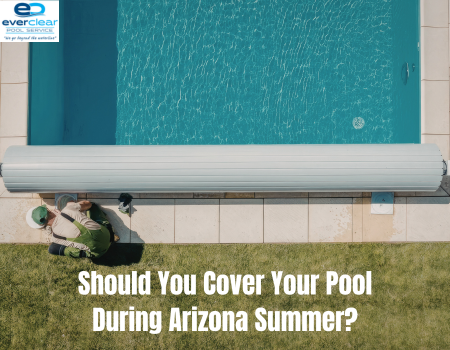
 The pool cover question in Lake Havasu gets asked every summer, and the honest answer is more useful than the simple one. Yes, covering the pool reduces evaporation. Yes, it saves water and chemicals. Whether it’s the right choice for every pool and every situation in Havasu’s specific climate requires a more specific answer than yes.
The case for covering the pool in Arizona summers is strong enough that most pool owners who understand the full math end up using one. The case against is real enough that knowing it changes how the decision gets made.
What a Cover Actually Does in Havasu Summer Heat
Evaporation in Lake Havasu during summer is aggressive in a way that surprises people who have moved from cooler climates. A pool losing a quarter inch to half an inch of water per day to evaporation alone under full sun exposure, low humidity, and consistent afternoon wind is losing a significant volume of water across a summer season. Every gallon of water that evaporates takes its dissolved chemical content with it in a specific way — the water leaves, the chemicals don’t, which means the chemical concentration in the remaining water increases as the level drops, and the top-off water that replaces it brings its own mineral load into a pool that’s already concentrating.
A cover on the pool overnight eliminates most of the evening and nighttime evaporation. During the day, it reduces the solar heating that drives the water temperature up and the evaporation rate along with it. A pool running in Havasu in summer without a cover that gets covered loses less water, meaningfully; uses fewer chemicals, meaningfully, to maintain balance; and runs at a lower temperature that reduces algae growth conditions. The water and chemical cost difference over a full Havasu summer season is real enough that the cover often pays for itself faster than most owners expect.
The solar cover, the most common option for residential pools, does something additional that a standard safety cover doesn’t. It absorbs solar energy and transfers it to the water, which in spring and fall extends the comfortable swimming season. In peak Havasu summer, when the pool is already warmer than most people want to swim in, that heat transfer works against comfort rather than for it. A solar cover in July and August is heating water that doesn’t need more heat, which creates the specific situation where covering the pool for evaporation control conflicts with covering it for temperature management.
The Temperature Problem
This is the nuance that makes the pool cover question in Havasu more complicated than it is in moderate climates. Water temperature in a Havasu pool during peak summer regularly sits in the mid to upper eighties without a cover. With a solar cover on through the day, it can climb into the nineties and above — too warm for comfortable swimming and warm enough to accelerate algae growth even with adequate chemical maintenance.
The practical resolution for most Havasu pool owners is covering at night and uncovering during the day through the peak summer months. Nighttime evaporation is where the majority of water loss happens anyway — the overnight temperature differential between the water surface and the cooler air creates conditions that accelerate evaporation in ways that the hotter but lower-humidity daytime conditions sometimes don’t match. Covering at night captures most of the evaporation savings without the daytime temperature problem.
A liquid solar blanket, an evaporation-reducing chemical that creates a microscopic barrier on the water surface, addresses the daytime evaporation without the temperature issue. These products aren’t as effective as a physical cover, but they’re significantly better than nothing, and they don’t affect water temperature or require any manual effort beyond adding a small amount to the pool on a regular schedule. For pools where removing and replacing a cover daily isn’t practical, the liquid alternative captures meaningful evaporation reduction without the management burden.
Chemical and Maintenance Implications
The pool that’s covered consistently loses fewer chemicals to evaporation and to UV degradation simultaneously. Chlorine stability in a covered pool is better than in an uncovered one because the cover limits the UV exposure that breaks down free chlorine in Havasu’s direct sun. A pool that’s struggling to hold chlorine despite regular dosing and adequate stabilizer levels has a UV exposure problem that a cover addresses directly rather than requiring higher stabilizer levels or more frequent chemical additions.
The cover itself needs maintenance that owners sometimes don’t anticipate. A pool cover in Havasu’s dust storm environment collects debris, dust, and organic material on its surface that gets introduced to the pool water when the cover is removed carelessly or when debris is blown off into the water. Cleaning the cover surface before removing it and storing it in a way that doesn’t let the dirty surface contact the pool water prevents the contamination that would otherwise partially offset the chemical savings.
The Actual Decision
For most Havasu pool owners, the calculation comes down to how the pool is used during peak summer. A pool that gets used daily during the day, where the cover needs to come off and go on every day, is a different situation than a pool that’s primarily used in the evenings and on weekends. The cover that sits on an actively used pool through the day creates more management burden than benefit during peak summer. The cover that goes on after the last swimmer gets out and comes off before the first one gets in captures most of the savings without constraining how the pool gets used.
The pool owner who decides not to cover should at a minimum understand the water and chemical cost of that decision rather than treating it as the default. In Havasu, where evaporation rates are extreme and chemical costs accumulate fast, the uncovered pool in summer is an expensive choice even when it’s the right one.
The Arizona Department of Environmental Quality’s water conservation resources cover evaporation rates, water usage standards, and conservation approaches for residential pools in Arizona’s extreme climate — an authoritative state context for Lake Havasu pool owners trying to understand the actual water cost of the uncovered pool decision in one of the state’s highest evaporation rate environments.