
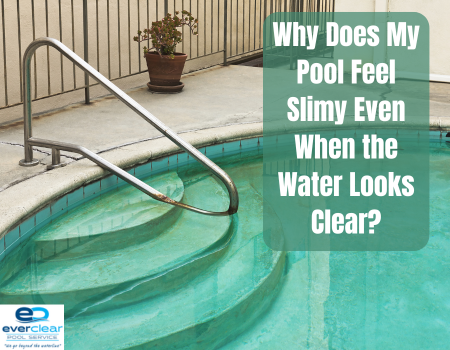
 Clear water and slimy walls are not the same problem, and treating them as if they are is why the sliminess keeps coming back despite what looks like adequate pool maintenance. The pool that tests fine on pH and chlorine, that looks clean from the deck, that doesn’t have any visible algae or cloudiness, can still have a biofilm problem on its surfaces that the water chemistry alone doesn’t address. The sliminess that feels wrong when stepping onto the steps or running a hand along the wall is communicating something specific about the pool’s condition that the water appearance isn’t showing.
Understanding Why Your Pool Feels Slimy
What the Sliminess Actually Is
Biofilm is the technical name for what pool owners experience as sliminess. It’s a thin layer of microorganisms, primarily bacteria and early-stage algae, that establishes on pool surfaces and produces a protective matrix of polysaccharides that gives it the characteristic slippery texture. Biofilm isn’t visible in the water because it’s attached to surfaces rather than suspended in the water column. It doesn’t affect water clarity because it’s not floating. It doesn’t necessarily show up in water chemistry testing because the chemistry of the water and the biology of the surface are not the same thing.
The biofilm that produces sliminess is the precursor stage to visible algae growth. The green pool that requires shock treatment and extended filter running to clear didn’t start as a green pool. It started as the thin biofilm layer on the walls and floor that the pool owner felt as sliminess and treated as a minor annoyance rather than an early warning. The warning was accurate. The response was inadequate.
Water at 88 to 92 degrees supports biological growth at a rate that the same pool water at 72 degrees doesn’t. The chemical program that kept the pool clean in spring becomes inadequate in July, not because anything changed about the chemistry but because the temperature changed the growth rate of the biology the chemistry is supposed to suppress.
Why Clear Water Doesn’t Mean Clean Surfaces
Chlorine works in water. It sanitizes the water column and kills micro-organisms that are suspended in it. What it does less effectively is penetrate the protective matrix that biofilm produces on surfaces. The polysaccharide layer that biofilm generates is specifically structured to protect the microorganisms inside it from the chemical environment outside it. A pool with adequate free chlorine in the water column can have established biofilm on its surfaces because the biofilm’s protective layer is reducing the effective chlorine contact at the surface texture.
This is why the pool that tests correctly and looks fine can still feel slimy. The water chemistry is addressing the water. The surface biology is operating in a partially protected environment that the water chemistry doesn’t fully reach. The distinction between water chemistry and surface chemistry is the distinction that explain the sliminess that appears despite adequate testing numbers.
Circulation dead zones compound this. The areas of the pool where water movement is slowest, the corners where two walls meet, the step risers, the area behind the ladder, and the floor section that the return jets don’t reach effectively are the areas where biofilm establishes first and most aggressively. These areas receive less of the chemical action that moving water distributes across the pool, and they receive less of the mechanical action from water movement that would otherwise disrupt surface attachment. The slimy step that’s the first place a pool owner notices the problem is almost always one of these low-circulation areas.
The Brushing Gap
Brushing is the mechanical intervention that disrupts biofilm before it establishes firmly enough to resist chemical treatment. A biofilm layer that’s been on the surface for three days responds to brushing in a way that a biofilm layer that’s been there for three weeks doesn’t. Early biofilm gets disturbed by brushing, gets suspended in the water column, and gets addressed by the chlorine that’s effective in the water. Established biofilm with a mature protective matrix requires more aggressive chemical treatment to address after the fact.
The brushing that prevents sliminess isn’t the weekly pass over the main wall surfaces that most pool owners do. It’s the specific brushing of the dead zones, the step risers, the corners, and the areas that don’t get circulation on a schedule that doesn’t allow biofilm to progress from the early stage, where brushing is effective, to the established stage, where it isn’t. In Havasu’s summer conditions, that schedule is more frequent than it is in spring because the growth rate is faster. A weekly brush that’s adequate in April may need to become a twice-weekly brush in July if the slimy feeling is appearing between service visits.
What Changes the Pattern
The pool that keeps feeling slimy despite what looks like adequate maintenance has usually been addressed at the water chemistry level without being addressed at the surface biology level. Getting the two addressed simultaneously is what changes the pattern rather than temporarily improving it.
Enzyme treatments are the chemical intervention specifically designed for biofilm rather than for suspended microorganisms. Pool enzymes break down the organic material that biofilm uses as a substrate and the polysaccharide matrix that protects established biofilm from chlorine contact. They work at the surface level rather than in the water column, and they complement rather than replace the chlorine program that addresses the water. A pool with an enzyme treatment added to its regular chemical program builds less biofilm between service visits than one without it.
Phosphate removal addresses the nutrient source that biofilm and algae require for growth. Phosphates enter the pool through fill water, through landscape runoff, through swimmer contamination, and through the organic debris that finds its way into every Havasu pool during dust storm season.
The CDC’s pool sanitation resources cover how biofilm establishes on pool surfaces, why water chemistry alone doesn’t address surface biology, and what sanitation approaches maintain both water quality and surface cleanliness — authoritative public health context that supports the article’s core argument about why a pool that tests correctly can still have a biofilm problem that the water chemistry isn’t reaching.