
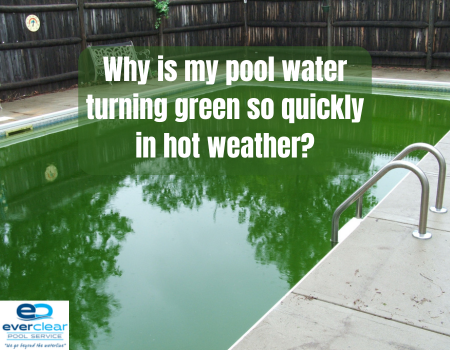
 A pool that turns green overnight in the Arizona summer isn’t a maintenance failure in the way it might look from the outside. It’s a predictable result of specific conditions coming together at the wrong moment — heat that accelerates every biological process in the water, chlorine that burns off faster than it’s being replaced, and algae spores that exist in every outdoor pool waiting for exactly this window. When those three things align, the water can go from clear to visibly green in less than 24 hours, and the speed of it catches people off guard every summer, regardless of how long they’ve owned a pool.
Understanding what actually triggered it changes how it gets fixed and whether it comes back.
Heat Does More Than Feel Hot
Water temperature is the variable that changes everything else in the pool chemistry equation during Arizona summers, and it doesn’t get enough attention relative to chlorine and pH in most pool maintenance conversations. Algae growth is temperature-dependent in a specific way — the warmer the water, the faster algae reproduce, and the reproduction rate isn’t linear. A pool sitting at 88 degrees isn’t slightly more hospitable to algae than one at 78 degrees. It’s dramatically more hospitable, and the window between adequate chlorine and insufficient chlorine narrows to hours rather than days.
The same heat that’s accelerating algae growth is accelerating chlorine degradation. UV radiation from Arizona’s direct sun breaks down free chlorine at a rate that surprises people who have moved from cooler climates. A pool that was dosed the previous evening adequately can be effectively chlorine-depleted by early afternoon the following day if stabilizer levels aren’t maintained in the range that slows UV degradation. The chlorine that was supposed to prevent algae growth is gone before the hottest part of the day arrives, and algae has the window it needs.
Pool water temperature in Arizona summer regularly sits in the mid to upper eighties and sometimes higher in pools with significant sun exposure and no shade. At those temperatures, the biological activity in the water is running at a pace that the maintenance schedule designed for a milder climate or a pool running at lower temperatures simply can’t keep up with. The pool that was fine all spring on a weekly service schedule needs something different in July and August, and the green water is what happens when the schedule doesn’t adjust to reflect that.
The Chemical Imbalance That Opens the Door
Algae doesn’t bloom in a well-maintained pool with balanced chemistry and adequate sanitizer. It blooms when something in the chemical balance creates a window of opportunity. Heat opens that window faster than anything else, but several specific chemical conditions determine whether algae takes advantage of it.
pH is the variable that most directly affects how well chlorine actually works. Chlorine at a pH of 7.8 is substantially less effective as a sanitizer than chlorine at a pH of 7.4. The same chlorine reading on a test kit produces different actual sanitizing capacities depending on where the pH sits. A pool with adequate chlorine levels and high pH can still turn green because the chlorine present isn’t working efficiently enough to prevent algae establishment. pH drifts upward faster in warm water than in cool water, which means the window during which chlorine is working at reduced efficiency is longer in Arizona summer than at any other time of year.
Phosphates are the algae food source that pools accumulate from multiple directions – fill water, leaf debris, dust storm deposits, lawn fertilizer runoff, and swimmer waste. High phosphate levels don’t cause algae directly, but they support algae growth when other conditions allow it to establish. A pool with high phosphates that has a chlorine gap has provided both the opportunity and the food source simultaneously, and the green water that follows is fast.
Stabilizer level is the variable that determines how long chlorine survives in direct sunlight. Cyanuric acid protects free chlorine from UV degradation, and pools that are low on stabilizer lose chlorine to sunlight dramatically faster than pools with adequate levels. The pool that keeps going green despite regular chlorine additions is often a pool with insufficient stabilizer running in direct Arizona sun — chlorine goes in and burns off before it can do its work, and then algae finds the gap. Adding chlorine without addressing the stabilizer level is adding it to a system that can’t hold it long enough to matter.
Getting the Pool Back
Green water requires more than a shock treatment to actually resolve, rather than temporarily improve. The algae that are visible in the water are already established in growth. Shocking kills it, but dead algae cells suspended in the water still cloud it and still feed the next bloom if the filter doesn’t remove them efficiently.
The full sequence that actually clears a green pool and keeps it clear starts with adjusting pH into the effective range before shocking, because shock applied to high-pH water works at reduced efficiency. Shock at dusk rather than midday, so it isn’t immediately degraded by UV before it does its work. Run the filter continuously until the water clears rather than on the normal daily schedule. Brush the walls and floor to suspend settled algae into the water column, where the filter can capture it. Check and address stabilizer level before resuming normal maintenance, so the chlorine that goes in after the green clears has a reasonable lifespan in Arizona sun.
The pool that turns green repeatedly through a single summer usually has an underlying condition that the shock treatments are masking rather than addressing. Low stabilizer, consistently high pH, inadequate filtration runtime, a filter that’s past peak performance, or a combination of these. Fixing the green water without identifying which of these applies produces a pool that’s clear until the next heat spike creates the same conditions again.
The CDC’s healthy swimming resources cover how pH, chlorine, and stabilizer levels interact to maintain safe pool water, what chemical imbalances create conditions for algae and bacterial growth, and what pool owners should understand about maintaining effective sanitizer levels in hot weather.